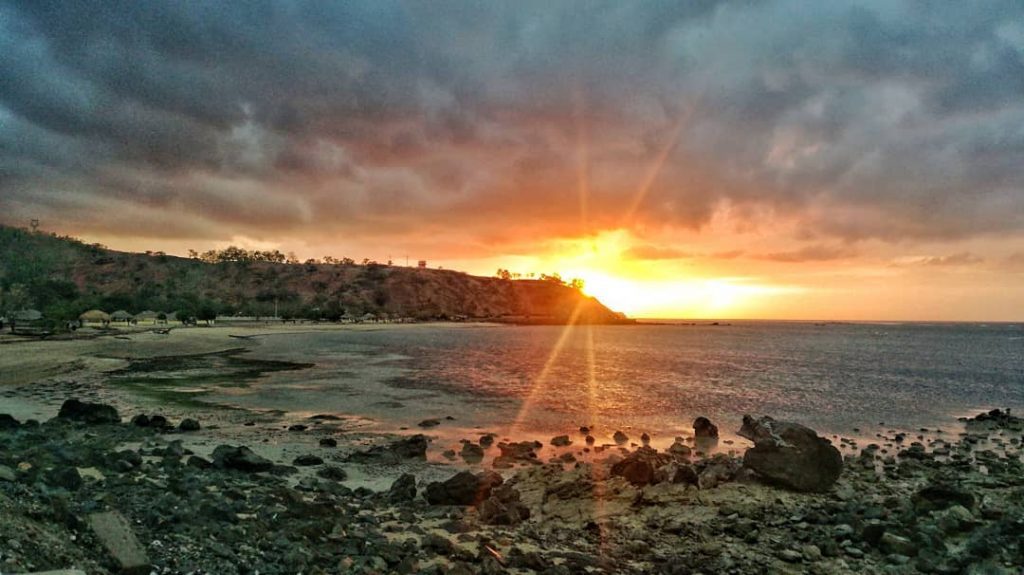
Legend, History, and Geography of Timor-Leste
The comprehensive guide to understanding Timor-Leste's ancient origins, rich cultural heritage, complex history, and unique geography
Overview
Timor-Leste stands as one of the world's youngest nations, yet its history spans 35,000 years of human civilization. From ancient Austronesian settlements to Portuguese colonization, Japanese occupation, Indonesian annexation, and finally independence in 2002, this remarkable country represents one of the most compelling stories of resilience and determination in modern history.
This comprehensive guide combines the beloved crocodile creation legend with authoritative historical timelines and detailed geographic analysis to provide complete understanding of this Southeast Asian nation.
The Legend: The Crocodile Creation Story
The sacred origin story that explains how Timor-Leste came to be Many years ago, before East Timor exists, a small crocodile lived in a swamp in a faraway place. He dreamed of becoming a big crocodile but, as the food was scarce, he became weak and grew sadder and sadder. He left for the open sea, to find food and realize his dream, but the day became increasingly hot and he was still far from the seashore. The little crocodile – rapidly drying out and now in desperation – lay down to die. A small boy took pity on the stranded crocodile and carried him to the sea. The crocodile, instantly revived, was grateful. “Little boy”, he said, “you have saved my life. If I can ever help you in any way, please call me. I will be at your command…” A few years later, the boy called the crocodile, who was now big and strong. “Brother Crocodile”, he said, “I too have a dream. I want to see the world”. “Climb on my back,” said the crocodile, “and tell me, which way do you want to go?” “Follow the sun”, said the boy. The crocodile set off for the east, and they traveled the oceans for years, until one day the crocodile said to the boy, “Brother, we have traveled for a long time. But now the time has come for me to die. In memory of your kindness, I will turn myself into a beautiful island, where you and your children can live until the sun sinks in the sea.” As the crocodile died, he grew and grew, and his rigid back became the mountains and his scales the hills of Timor. Now when the people of East Timor swim in the ocean, they enter the water saying “Don’t eat me crocodile, I am your relative”. From the East Timor’s Independence Day Committee (in: etan.org )
Comprehensive History of Timor-Leste
From 35,000 years of human civilization to modern independence - the complete historical timeline
Ancient Period: 35,000 Years of Human Presence
Prehistoric Settlements (35,000 years ago)
- Archaeological evidence confirms Neolithic settlements dating back 35,000 years
- Early Austronesian hunter-gatherers were the first inhabitants
- Asian migrants later introduced sophisticated agricultural practices
- Complex social structures developed including:
- Hierarchical kingdoms with sophisticated governance
- Strategic marital alliances between communities
- Established land use laws and territorial systems
- Tribute exchange systems facilitating trade
Early Trading Networks (13th-15th Centuries)
- Javanese and Chinese traders established regular contact
- Valuable resources attracted international attention:
- Sandalwood (highly prized in Asia)
- Honey and beeswax
- Spices and other tropical products
- Regional integration into broader Southeast Asian trading networks
Colonial Period: Four Centuries of Foreign Rule
Portuguese Colonization (Early 16th Century - 1975)
Arrival and Establishment:
- Portuguese first arrived in early 16th century (around 1520s)
- Eastern Timor became Portuguese colony for over 400 years
- Western Timor was simultaneously colonized by the Dutch
- Longest continuous colonial relationship in Southeast Asia
Colonial Characteristics:
- Alliance strategy: Formed partnerships with existing local kinship structures
- Economic transformation: Introduced new agricultural systems:
- Coffee production (became major export)
- Sugar cane cultivation
- Cotton farming
- Religious conversion: Spread of Catholicism throughout the territory
- Resistance and uprisings: Periodic local rebellions due to:
- Excessive local taxation
- Forced labor practices
- Cultural suppression
World War II: Devastation and Heroism (1941-1945)
Pre-War Division:
- Territory initially divided between Dutch and Portuguese colonial powers
- Strategic location made Timor crucial for Pacific war efforts
Allied Intervention and Japanese Invasion:
- Allied troops landed in 1942 (Australia, UK, Netherlands)
- Japanese invasion followed shortly after
- Japanese occupation lasted throughout the war
Timorese Contribution and Sacrifice:
- Timorese assisted Allied forces through:
- Providing food and shelter to Allied soldiers
- Active participation in guerrilla warfare
- Intelligence gathering and resistance activities
- Devastating human cost: Approximately 50,000 Timorese lives lost
- Widespread destruction of infrastructure and communities
Indonesian Occupation: The Darkest Chapter (1975-1999)
Invasion and Annexation
- December 7, 1975: Indonesia invaded 9 days after Timor-Leste declared independence from Portugal
- Became Indonesian province under Suharto's New Order regime
- International community largely remained silent
Brutal Occupation Period
- Systematic violence: Over 200,000 Timorese killed (one-third of population)
- Cultural suppression: Attempts to eliminate Timorese identity
- Forced assimilation: Indonesian language and culture imposed
- Economic exploitation: Resources extracted for Indonesian benefit
Timorese Resistance Movement
Three-Front Strategy:
- Armed resistance: Guerrilla warfare in mountains and rural areas
- Clandestine networks: Underground organization in cities and towns
- Diplomatic campaign: International advocacy and awareness-raising
Key Resistance Milestones:
- FRETILIN formation: Revolutionary Front for an Independent East Timor
- Xanana Gusmão leadership: Charismatic resistance commander
- Santa Cruz Massacre (1991): International attention to Indonesian brutality
- Nobel Peace Prize (1996): Awarded to Bishop Carlos Ximenes Belo and José Ramos-Horta
Path to Independence
- 1997 Asian Economic Crisis: Weakened Indonesian position
- Suharto's fall (1998): Created political opening
- 1999 Independence Referendum: UN-sponsored consultation
- 78.5% voted for independence
- Followed by militia violence and systematic destruction
- UN intervention: INTERFET peacekeeping force deployed
Independence Era: Building a New Nation (1999-Present)
Transition Period (1999-2002)
- UN Transitional Administration (UNTAET) established
- Massive reconstruction efforts began
- Institution building: Creating democratic governance structures
- International support: Unprecedented international assistance
Formal Independence (May 20, 2002)
- Historic ceremony: At Tasi Tolu, site of former mass grave
- International recognition: Became UN member state
- Democratic institutions: Constitution, parliament, presidency established
- Xanana Gusmão: Elected first president
Modern Challenges and Achievements
- Economic development: Building sustainable economy beyond oil/gas
- Institution strengthening: Developing democratic governance
- Reconciliation efforts: Truth and Reconciliation Commission
- Regional integration: ASEAN membership, UN participation
- Ongoing development: Education, healthcare, infrastructure improvements
In May 2002, after 450 years of continuous foreign occupation, East Timor became the newest independent country in the world. The island of Timor Leste is located towards the eastern end of the Indonesian island chain running from Malaya through Sumatra and Java, New Guinea. The island is divided into two parts. Most of the western half remains part of Indonesia. The eastern half forms the largest part of the national territory of Timor, with its capital, Dili , on the north coast, a small enclave on the western half around the city of Oecussi and Atauro small island, 30 km (19 miles) north of Dili. Let us learn a little bit more about the history of East Timor The pre-occupation of Timor Leste history is sketchy. The migration of many people along the track of Southeast Asian monsoon from northwest to southeast, of course, led to the population of the island by a civilization that had no written records, but worked in iron and had a relatively sophisticated system of agriculture. The island was connected to a regional trading system centered on Java, which spread to China and India. The Portuguese first arrived on the island in the early 16th century and by the 1550s occupied the eastern part. The Dutch took control of the western part, which became part of the Dutch East Indies and, after independence, Indonesia. During the Second World War, Portugal, then ruled by a fascist dictatorship, was formally neutral – a statute that extended their colonies. However, that did not stop the Allied moving into East Timor in late 1941 units, apparently to pre-empt the Japanese invasion. The Japanese, in fact, invade, in February 1942, defeating the Dutch forces / combined Australian and occupy the territory until its liberation in 1945 Portugal regained possession and remained in control until the Portuguese Revolution of 1974. In 1975, the new government left Portuguese abandoned all their colonies. East Timor then enjoyed a few days of independence, before the Indonesians, who had long coveted territory, annexed it as a province. There were little local resistance and the international community largely acquiesced. The main Timorese independence movement, Fretilin (Revolutionary Front of Independent Timor This), which was originally formed to fight the Portuguese, now had to gear up again to fight a new and even more brutal occupier. In the violent counterinsurgency campaign that followed, the Indonesian army killed more than 200 000 Timorese. (Learn more about East Timor genocide ) East Timor’s history tells that with the capture in 1992 of the legendary leader of FRETILIN, Xanana Gusmão, the prospects looked bleak for the movement. It was not until the Asian economic crisis of 1997 and the subsequent removal of the veteran Indonesian President Suharto that the growing international criticism of Indonesia’s campaign began to have some effect. In June 1999, President Habibie of Indonesia suddenly announced that a referendum would be held in East Timor, offering independence or autonomy within Indonesia. The referendum was held in August 1999 and 80 percent opted for independence. By way of revenge, the Indonesian army, along with local militias were armed and funded, indulged in an orgy of destruction and death that displaced hundreds of thousands of people and destroyed the already fragile economic base of the country. A truth and reconciliation commission on the South African model, has been established to investigate the events of that period, and several senior Indonesians, including an army general, once they have been convicted of complicity in human rights abuses. In October 1999, a transitional UN administration (UNTAET) was established in East Timor, pending the holding of national elections. Furthermore, Gusmão was released from prison. The assembly returned the survey in August 2001, as expected most candidates FRETILIN; Mari Alkatiri, FRETILIN also assumed the Premiership. The Presidency challenged in April 2002, was won by Xanana Gusmão, with a large majority. The new government sought to develop international contacts – with the UN, ASEAN and the South Pacific Forum – ASAP. Adherence to the IMF and World Bank was secured in July 2002, followed by joining the UN in September. Relations with its two more powerful neighbors, Indonesia and Australia, are also of high priority (see section Economy). The new country faced a massive task of reconstruction (see section Economy), and the government has found it difficult to fulfill many of its early promises. By the end of 2002, there were a number of violent confrontations between the frustrated population and the security forces of the government. The government has been supported by a force of residual UN, now known as UNMISET (United Nations Mission in East Timor), who took over from UNTAET in May 2002. History of Timor Leste (Step by Step List)
- Ancient history and peoples Archaeological excavations and art found on rock testify to its long and significant ancient history. Evidence that new peoples arrived on the island about 3500 years ago can be found by the initial influences on the different languages and dialects of the districts, the profusion of ancient cave paintings and rock shelters in the presence today of domesticated animals such as chickens, pigs and dogs, and even articles such as pottery. The history of human occupation in East Timor dates back 43,000 years before the present time. The island of Timor served as a bridge to the first migrations of peoples from all over that region to Sahul, the old continental mass linking Australia to New Guinea.
- First External Contacts and Portuguese Colonization Timor attracted Chinese and Malaysian merchants in the thirteenth century, attracted by the abundance of sandalwood, honey, and wax. The same natural resources brought the Portuguese settlers into the area in the early sixteenth century, and they brought with them the Catholic faith, which remains the dominant religion today, although the Timorese continue to maintain their traditional animist beliefs.
- World War II When World War II broke out, the Australians and Dutch, aware of Timor’s strategic position in the region, landed in Dili despite the protests of the Portuguese. The Japanese used the Australian presence as a pretext for an invasion in February 1942 and remained until September 1945. By the end of the war, Timor was in ruins, and approximately 50,000 Timorese had lost their lives in the effort to resist the invaders and protect Australia.
- Portuguese decolonization and the Timorese independence movements After World War II, the territory reverted to Portuguese administration; it ruled Timor-Leste with a combination of direct and indirect administration, controlling the population as a whole through traditional power structures rather than using colonial public officials. This has allowed the traditional Timorese society to remain virtually intact. However, in 1974, the “transition to democracy” in Portugal had a sudden impact on all its colonies. A process of decolonization had begun in Timor; in August 1975, a civil war broke out among the newly formed political parties in the country, and shortly thereafter, on 28 November, Timor-Leste unilaterally proclaimed independence from Portugal. Ten days later, on 7 December 1975, Indonesian troops invaded the country.
- 1975-1999: The Indonesian Occupation Some 60,000 people were killed in the early years of Indonesian annexation – contributing to a total of 200,000 deaths throughout the period of its administration. The Timorese resistance fought on two fronts: at home, on the ground, and overseas, through diplomatic channels. The killing of about 250 people committed by the Indonesian army during a funeral at the Santa Cruz Cemetery marked a turning point in the struggle for independence as shocking images were broadcast around the world. Personalities and organizations have begun to put increasing pressure on their governments and international organizations in favor of Timor-Leste. The imprisonment of the resistance leader, Xanana Gusmão, in 1992 also put the issue of human rights in the limelight. Indonesia was in an increasingly difficult position, culminating in October 1996, when the Nobel Peace Prize was awarded to two Timorese leaders, Bishop Ximenes Belo and José Ramos Horta, contributing to the movement’s increasing assertiveness towards independence. Finally, in an agreement reached under the auspices of the United Nations, the Timorese people were allowed to choose between total independence or autonomy under Indonesian administration, in a popular consultation held on 30 August 1999.
- 1999: Voting for Independence In September 1999 the result of the popular consultation was announced. The people of Timor-Leste voted overwhelmingly – 78% – in favor of Indonesian independence. The pro-integrationist militia groups and the Indonesian military responded with extraordinary brutality, spreading violence and looting almost the entire country, systematically destroying most of its infrastructure. As a result, two-thirds of the population was displaced, and between 1000 and 2000 people were reported as dead in the violence. A United Nations multinational force (INTERFET) was brought in to restore peace and security. When the Timorese began work on building their new independent nation, the United Nations acted as supervisors during a transition administration known as UNTAET.
- Year 2002: A New Beginning On 30 August 2001, Timor-Leste had its first free elections – for deputies charged with writing a new constitution. On May 20, Timor-Leste became the world’s newest democracy and the first new country of the third millennium. The celebrations took place in Tasi Tolu, near Dili, in a former mass grave, with dignitaries such as United Nations Secretary-General Kofi Annan, former President Bill Clinton, and perhaps more President Megawati of Indonesia, who received a standing ovation from the crowd. At midnight on May 19, the new flag of Timor-Leste was erected, the new national anthem was sung, and the long struggle for freedom was finally over. Today, Timor-Leste is a country that is taking its first steps in freedom and true democracy. The rich, diverse community of Timor-Leste reflects its varied and distinct historical influences, as it welcomes everyone in a warm and friendly, now that the country has finally found peace. Check what to do in Timor Leste .
Geography and Climate of Timor-Leste
Comprehensive analysis of Timor-Leste's unique geographic features, diverse landscapes, and tropical climate systems
Geographic Location and Territory
Strategic Position
- Location: South-East Asia, positioned 400km north of Australia
- Island chain position: Lesser Sunda Islands at the eastern end of Indonesian archipelago
- Total territory: Nearly 15,000 square kilometers
- Maritime boundaries: Surrounded by Timor Sea, Banda Sea, and Ombai Strait
Territorial Components
Timor-Leste comprises four distinct areas:
- Eastern half of Timor Island: Main territory with capital Dili
- Oecusse Enclave: 815 km² enclave in West Timor
- Atauro Island: 141 km² island, 30km north of Dili
- Jaco Island: 11 km² uninhabited island at eastern tip
Topography and Landforms
Mountainous Terrain
- Rugged, mountainous landscape dominates the territory
- Central mountainous backbone rises over 2,000 meters
- Nearly half of land area has slopes of 40 degrees or more
- Challenging terrain creates difficulties for:
- Road construction and maintenance
- Agricultural development
- Infrastructure development
Major Mountain Peaks
- Mount Ramelau (Tatamailau): 2,986m - Highest point in Timor-Leste
- Mount Cablac: 2,000m+ - Ermera/Ainaro border
- Matebian Mountain: 2,000m+ - Baucau/Viqueque region
- Mount Loelaco: Eastern region
- Merique Mountains: Eastern mountainous area
Coastal Features
- North coast: Warmer, irregular coastline
- South coast: Alluvial plains with more moderate climate
- Highland plains: Notable formations west of Baucau
- Narrow coastal areas: Limited flat coastal land
- Rocky headlands: Dramatic cliff formations
- White sand beaches: Pristine coastal environments
- Extensive fringing reefs: Rich marine ecosystems
Water Resources and Hydrology
River Systems
- Seasonal rivers: Most rivers dry during dry season
- Wet season torrents: Rivers become raging torrents during rainy season
- Flash flooding: Common during intense rainfall periods
- Limited permanent water: Challenges for agriculture and development
Lakes and Water Bodies
- Lake Ira Lalaro: Only significant natural lake
- Smaller salt lakes: Coastal saline water bodies
- Coastal marshes: Important wetland ecosystems
- Geothermal hot springs: Multiple locations with therapeutic potential
Climate Systems
Tropical Climate Characteristics
- Hot tropical climate year-round
- High humidity throughout the year
- Intense solar radiation due to proximity to equator
Seasonal Patterns
Two Distinct Seasons:
Dry Season (May-November)
- Lower rainfall: Minimal precipitation
- Better road conditions: Improved accessibility
- Clear skies: Optimal for outdoor activities
- Cooler temperatures: More comfortable conditions
- Southeast trade winds: Moderate humidity
Wet Season (December-April)
- Heavy monsoonal rains: Intense precipitation
- Flooding potential: Rivers overflow, roads impassable
- High humidity: Tropical conditions intensify
- Landslides: Mountain areas particularly affected
- Lush vegetation: Dramatic landscape transformation
Temperature Variations
- Coastal areas: 25-35°C year-round
- Mountain regions: Significantly cooler, sometimes misty
- Thermal amplitude: 15°C (mountains) to 30°C (coastal)
- Altitude effect: Temperature decreases with elevation
- Microclimates: Diverse conditions from dry hillsides to lush forests
Geographic Challenges and Opportunities
Development Challenges
- Mountainous terrain: Limits infrastructure development
- Steep slopes: Erosion and landslide risks
- Seasonal accessibility: Remote areas isolated during wet season
- Limited flat land: Constraints on agriculture and urban development
Natural Advantages
- Marine biodiversity: World-class diving and marine tourism potential
- Scenic landscapes: Spectacular mountain and coastal scenery
- Diverse ecosystems: From coral reefs to mountain forests
- Strategic location: Gateway between Asia and Australia
- Geothermal potential: Renewable energy opportunities
Population Distribution
- Over 1.3 million inhabitants (2023 estimates)
- Coastal concentration: Most population along northern coast
- Urban centers: Dili (capital), Baucau, Maliana, Suai
- Rural majority: Most Timorese live in rural communities
- Mountain communities: Traditional villages in highland areas
This geographic diversity creates one of the world's most varied and spectacular small nations, offering everything from pristine coral reefs to misty mountain peaks, making Timor-Leste a unique destination for travelers seeking authentic natural and cultural experiences.
Understanding Timor-Leste Today
Timor-Leste represents one of the world's most remarkable stories of survival, resistance, and renewal. From its ancient origins 35,000 years ago through centuries of colonial rule, brutal occupation, and finally to independence, this nation embodies the triumph of human determination over seemingly impossible odds.
Today's Timor-Leste combines:
- Ancient traditions with modern democratic governance
- Rich cultural heritage with contemporary development aspirations
- Spectacular natural beauty with emerging tourism potential
- Resilient communities with welcoming hospitality
For visitors, understanding this comprehensive history and geography provides essential context for appreciating the remarkable journey of Southeast Asia's youngest nation and the warmth of its people who have preserved their culture through centuries of challenge.
Related Resources:
- People & Culture - Understanding Timorese society
- Why East Timor - Compelling reasons to visit
- Practical Travel Guide - Essential planning information
Images